Skip to content
saanjha
Food, close to home

Home-cooked food, from the kitchen down the corridor.

Tiffin providers with real plans, and neighbours who cooked a little extra. It is about home cooking and local discovery — not an open restaurant marketplace, and not a delivery race.

What it covers

Two kinds of food, one set of rules.

A monthly tiffin business and a neighbour with a spare portion look different commercially, and identical from a food-safety point of view. Saanjha treats them as one module with one safety spine.

Tiffin plans

Daily, weekly or monthly, vegetarian and non-vegetarian, pickup or delivery — with availability specific to your community rather than a city-wide menu.

“I’m cooking biryani today. Interested?”

A neighbour cooking a little extra can offer portions to the community. Others reserve one, collect it, or have it delivered where that exists.

Capacity that is real

A cook can only sell the portions they can actually make. The number of portions is the constraint, not a setting — which is why the food arrives.

Subscriptions that allow a life

Skip a day, pause a week. A tiffin subscription that assumes you eat the same thing every single day is where most of the disputes come from.

Allergens as structured data

Declared as fields, never buried in a sentence. A person with a severe allergy cannot be asked to parse prose written by a stranger in a hurry.

FSSAI where it applies

Registration is mandatory where the law requires it, held by the person cooking — not treated as a nice-to-have that can be self-declared away.
Safety

The part we are least willing to be casual about.

Saanjha’s own design documents originally ruled out prepared food entirely. That decision was reversed — and the conditions attached to reversing it are gating requirements, not aspirations.

  • FSSAI registration is not “where legally required” as a shrug. It is mandatory where it applies, and it is checked as part of onboarding rather than collected afterwards.
  • Allergens are structured data, never prose. They are captured as fields so they can be filtered, matched against a member’s profile, and surfaced before an order rather than after.
  • Recall tooling is a gating requirement. If something goes wrong with a batch, the ability to identify and reach everyone who received it has to exist before the food does.
  • The sharing/commercial line is measured, not declared. Whether someone is a neighbour sharing a surplus or a business selling meals is determined by what they actually do — volume, frequency, regularity — not by which box they ticked.

For the person cooking

A kitchen business without a storefront.

Most home cooks who want to sell are stopped by the same three things: reaching people, taking orders reliably, and getting paid.

Your own community

The households nearest you are the households most likely to want lunch. Discovery starts there rather than city-wide.

Orders before you cook

Portions are reserved against a real capacity, so you know what to make before you buy the ingredients.

Paid directly

UPI to your own ID, or cash at pickup. Nothing is deducted from the price, and nobody holds your money.

Being straight about it

What this is not.

  • Not a restaurant marketplace. No cloud kitchens, no thirty-minute promise, no aggregating every eatery in the pin code. Home cooking and local discovery is the whole scope.
  • Not available everywhere. Food rolls out community by community, behind the safety requirements above. Availability differs by area.
  • Not a food-safety guarantee. Verification and FSSAI registration tell you a cook has met a standard. They are not a promise about any individual meal, and we will not describe them as one.

In the app

Allergens are a form field, not a sentence.

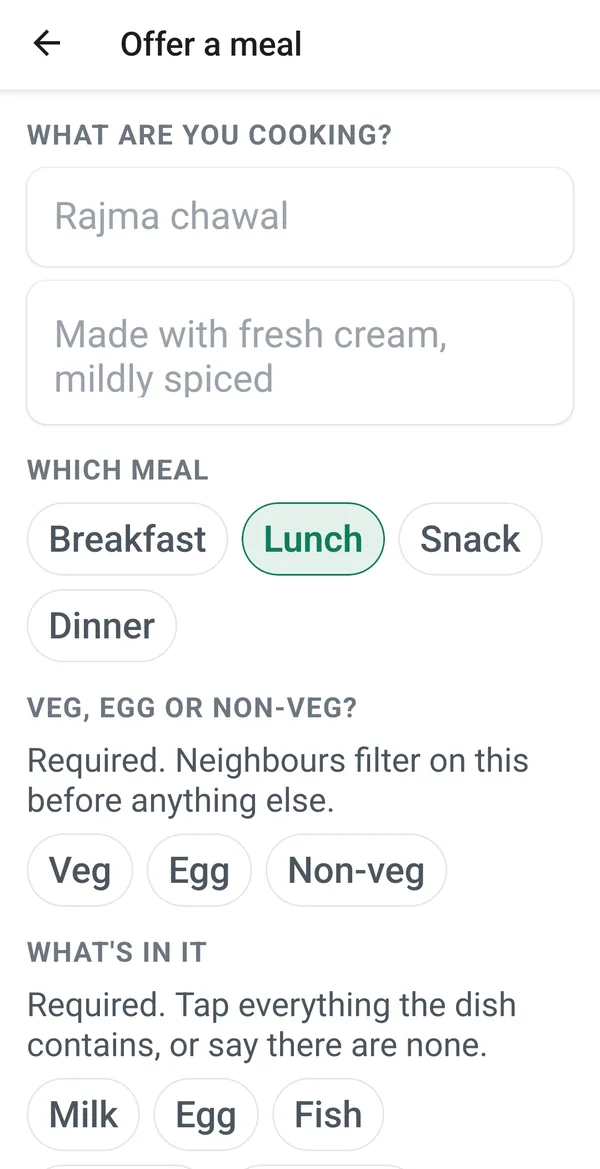
This is the screen a neighbour fills in before they can offer a portion. Veg, egg or non-veg is required because that is the first thing anybody filters on, and what is in it is required because a person with an allergy cannot be asked to parse prose.

  • The Offer a meal screen, asking what you are cooking, which meal, whether it is veg, egg or non-veg, and requiring every allergen the dish contains to be tapped.

    Offering a meal. Both the veg marking and the allergen list are required fields — the form will not let them be skipped.

Real screens from the Saanjha Android app. Some content varies by community, and what you see depends on which sellers and services are active where you live.

Lunch, from four doors away.

Available now on Android and iPhone. You’ll need an invite from a neighbour to join a community.